Saturday, 21 April 2012

Where did all the tomatoes go?


I seem to have lost the title of “trauma magnet.” The trend over the past few months is that I would walk into casualty to show my face and say: “Hi, I’m on call,” the nurses would sigh and say: “Aybo! Doc, you get too much traffic.” What they are very politely trying to say is that whenever my name is on the rota, I seem to attract chaos – be it the result of a fracas, a road traffic collision or obstetric and gynaecological problem. This means work for me and work for my nursing colleagues. My blood stained sneakers are good evidence of how messy some affairs can be. However, I think I have lost my magnetism. Friday night saw only one gunshot wound in the knee and nothing else. I had some very sweet dreams.   
The expansion of our medical team has meant that we are all on call a lot less (probably why I am no longer so magnetic – probability always wins). The downside of fewer on calls means that I don’t get to deal with so many “juicy” cases. However, the upside is that we can really start to think about how we can develop Holy Cross into a centre of excellence. I may have used the wrong abstract noun there, but it is all relative – we need to strive to provide a better service at least.
This week saw our first meeting, to be held monthly, where we discuss issues with clinical and non-clinical staff and attempt to resolve them. In fact, the meeting was held on the same morning as the teaching programme that I have started. Needless to say, I have postponed the discussion until next week as the forum went on for some time. There were plenty of topics debated – our water supply (currently we only have running water between 6 and 8 in the morning – obvious dilemma with hygiene, but also with hydrating our patients and staff); out of hours radiology service (the radiographer said that he was on board with the idea if he gets paid extra. However, he also said that if he did get paid, it would still be voluntary.); management and fast tracking of sexual assault victims; broken machines all over the hospital (including the monitor in theatre – quite essential to monitor a patient’s heart rate, blood pressure and oxygen saturations.); pharmaceutical supplies. It was actually a very interesting and dynamic meeting, with some good contributions from nearly everyone present – although, I’m not sure about the views of the radiographer and his volunteer paid out of hour’s service. Surely that is a massive oxymoron. I just hope we can be productive and put plans into action rather than just debate issues over and over.
***
Whilst on call yesterday, during a lull, I found enough time to donate blood. The donation van comes around every two months, but quite ashamedly, I hadn’t donated until now. This is largely because I either had no idea it was here or I was too busy. I’m not sure if giving blood at the start of a 24 hour shift is a good idea – fortunately, Friday night was super quiet. I was quite surprised by how many people were reluctant to donate. There were plenty of vague excuses, although I’m sure some of them had good foundations, such as being HIV positive but, quite reasonably, not wanting to disclose the information to me. There is a massive shortage in blood stocks everywhere, so, if you’re reading this: GO DONATE TODAY.
***
My car Mitch has recently been accessorised with a lovely hat and pipe, more commonly known in the industry as a roof tent and snorkel, respectively. This is all in preparation for the two months I am taking off in July and August to drive up to Uganda (if time permits).
“Why have a snorkel?” I hear you ask? “To drive through rivers,” I say. “Oh,” you say.
The tent has already been tested for sturdiness by my neighbours, who decided to clamber all over the canvas. It shall have its maiden voyage next week when I drive to the Karoo Desert (near Cape Town) for a festival called AfrikaBurn. It’s based on the Burning Man in the Nevada Desert. Hopefully I won’t come back zombified and wearing nothing but a loin cloth.
***
The vegetable patch has been coming on just swell. Unfortunately, for all its luscious looks (the flowers are radical – my house has lots of empty beer bottles donned with pink, yellow and red bloomers) I haven’t been able to be self sufficient. There seems to be a tomato thief lurking in the shrubs as every time I go away for the weekend, the toms that were about to get that “sun kissed” look disappear. I just hope they go to a good home. Thyme, parsley and coriander play a heavy role in my cooking – it just so happens I have an abundance of them growing in my patch.
First festival of the season: Splashy Fen. Friends walking down the promenade - no need for wellies (although people were still wearing them). 


Splashy Fen, this man had the most incredible mullet. One cannot really appreaciate it in this photo, but I quite like it nonetheless.


First meeting of clinical and non-clinical staff since early 2011.


The neighbours modelling alongside Mitch and his new accessories.


Giving blood between patients - it's in their interests, but maybe not in the short term if I start feeling a little faint.

Friday, 6 April 2012

Miracle Makers

Easter has begun and I am fortunate enough not to be working the long weekend. Word in the hospital is that Easter is much like Christmas: families and friends coming together with knives and fists. People keep telling me it’s a cultural thing. I am sure there is a simple enough equation that can explain the festive fun: ((Money × Alcohol2) + difference of opinion) ÷ (Love + rational thought) = x. ‘x’ may be a kiss on the cheek or a stab in the face, depending on the weight of the different variables. Take away the liquor and I expect one would see a massive reduction in violence.  However, life isn’t that simple and one cannot simply things down to a silly equation. The social issues and inequalities here in South Africa are gargantuan – something that I am still trying to get my head around.
Not working Easter apparently means I should be spending it at Church, according to my nurses. “Gawping amazement” is how I would describe the look on their faces when I tell them I don’t subscribe to their school of thought and that I shall be spending most my time at a music festival. However, occasionally I feel I could almost believe in some kind of supernatural force: the seven month old infant that was shot in the chest last week in the hands of her dying mother came back today. By some miracle, the bullet prodded it’s way around the lung and ended up in the muscles surrounding her abdomen.  She was giggling and smiling while I stood there with a massive grin slapped over my face. I discharged her with the bullet still lodged inside. The aunt will look after the baby. On a side note – the aunt found the helicopter ride terrifying.
***
Often one is presented with an interesting history written on the casualty card. Often this is the result of a dodgy Xhosa to Zulu to English translation. The first time I saw: “Struck by lightning,” written down I felt my own heart beat accelerate rapidly – however, a quick glance at the smiling patient swiftly relieved my initial fear. Being struck by lightning in the physical sense is a very loose term here – however, the social and cultural connotations are massive. A home that has been “struck” by lighting must be abandoned and if a person is “hit”, they may be ostracised by the community. Lighting is the ancestors saying: “We are not very happy with your affairs at the moment – you must be punished.”
This week I have seen two patients where I assumed the history on the casualty card was misinterpreted.  The first was a girl in her early twenties who came with the story: “glass stuck in foot for three years.” Obviously it was three days, and not years. No, I stood corrected, it was three years. Being slightly cynical of her story I examined her. She was rather tender in the said area, but still I didn’t believe it. Glass shows up remarkably well on an x-ray, especially the two large shards that she had in her foot. I referred her to my surgical colleagues.
The second history was that of: “Tick in ear.” How can one possibly know it’s a tick in the child’s ear? It could be anything – far more likely to be a bean or cotton bud. The mother hadn’t seen it, but, without giving any reasonable explanation, she was adamant it was a tick. Much like the other pathognomonic sign for worms that grandmothers often like to describe: “The child is grinding their teeth at night.” Low and behold, the child had a gargantuan tick in their ear gnawing away at a tasty bit of ear canal.
***
I thought I had turned into a miracle worker yesterday. I reduced an angulated forearm fracture of a child under ketamine with that satisfying grinding click of the opposing bones realigning under a bit of manual pressure. The subsequent x-rays looked as if he had never broken his arm in the first place. For a brief second I thought that I had manipulated and plastered the wrong arm; then I thought I had performed some sort of divine intervention; finally I realised the two repeat x-rays were of the same view (one always needs to look at the bones in two angles to create a kind of 3D picture). The second x-ray showed that the results were not perfect, but pretty good if I do say so myself.
***
I should probably mention that this week was my last on the paediatric unit. One of the sister’s in charge was extremely upset when I told her the news – very flattering. However, it is time for a change and with our new cohort of doctors we can spread our wings a little. I shall be spending the next four months trying to help the medical ward recover from a dismal year of neglect and try to clear the cobwebs from my murky medical brain.
The mega tick that I fished from a toddler's ear. Notice the hunk of ear canal still being gnawed on by a very alive critter.
I shall miss paediatric ward rounds - the kids start to join in once they've been around for a while.
Now you see it, now you don't. The fractured forearm that I thought I had miraculously reduced. Unfortunately, the image on the right shows the same view. However, the arm is much better than it was.

Happy punters.

"slash and burn" next to the diesel generator tank.


Happy punters make happy workers.

The nature reserve (Mkhambathi) at the end of my road is magnificent.

Burger boy.

The South Africans love a braai (BBQ). I have turned my fire place into an indoor braii - my new favourite cooking station.

Improvisation can be key sometimes - this lady was referred from clinic with a septic operation wound. They have used sticky labels as tape - the adhesive, unfortunately, can be an irritant. Her skin was fine, however.
Here she is - the 7 month old infant who was shot in the chest. A very moving tale and a true wonder that she survived.

Friday, 30 March 2012

CHOPPER.

Something rather exciting happened yesterday. I gave a presentation on the recently updated WHO (World Health Organisation) tuberculosis management guidelines. After the presentation I went to theatre to perform my 90th (documented) spinal anaesthetic since I have arrived. That is almost 100. Maybe I’ll celebrate by giving my patient something a little something special on the centenary, such as a sticker congratulating my one hundredth patient or a little intravenous shot of fentanyl (an analogue of morphine – don’t worry, I’m not going to do that). Nope, as thrilling as that all sounds, this is not what I want to talk about. What I want to mention is something that my paediatric nurses were trying to call me about just before I walked into theatre Thursday morning to perform spinal anaesthetic number ninety. There was a seven month old infant admitted in Calloway (the paediatric unit) having suffered a gunshot.
When I was informed of the news, two things surprised me. It wasn’t that the baby had been shot whilst in her mother’s arms, who was killed alongside the aunty. What surprised me the most was that the infant had been admitted to my ward (the usual protocol is that ANY gunshot victim should be stabilised and transferred to a surgical unit – bullets can be very unpredictable) and secondly that she was still alive.
A brief assessment revealed that the baby was pretty stable. She had an entry wound in the top left corner of her chest and the bullet had ended up in her abdomen. There was bleeding around the lung (a haemothorax) and, I expect, a whole load of punctured bowel. Kids can be very deceptive – one minute they are fine, even if a large bullet has made a small journey through some of their vital organs – and suddenly, they will decompensate and die very quickly if not managed appropriately. Quite frankly, I have had enough of children dying from traumatic injuries and it feels like it has happened far too often recently – such as the five year old who suffered severe internal bleeding after being struck by a car a few weeks ago. If only he could have got to a surgical facility in time. We waited for five hours until the ambulance never arrived and he said goodbye to this world.
As mentioned before, the ambulance service is pretty dismal here (I guess the flip side of the argument is at least we have one). However, there is one exception: Did I ever mention Holy Cross has a helicopter pad?
 Once the infant was stabilised I called Metro (the ambulance control board) and explained my case; I asked for air support as I was worried the infant would suddenly turn. The response I got was: “You want a chopper? Ok, I’ll call you back.” Four brief phone calls later I spoke to a lovely paramedic in East London, where the chopper is based – about 6 hours drive from here. I was expecting to be let down, instead her final words were: “OK then, we’ll be with you in about an hour.” Eureka! The adrenaline started flowing through my veins – I can’t explain why – I was teaming with excitement. However, I didn’t let this show – I wanted to remain composed in this delicate situation. The response of my nurses when I told them was of sheer joy – so, I let them do the singing and dancing whilst I nervously waited and checked on the baby every fifteen minutes whilst I continued with ward rounds as usual.
After a slight detour from being given the wrong coordinates, the pilot called me from the aircraft for directions – a lot easier than you would expect: “Just follow the tar road and look for me waving.” The plan worked very well. It was a magnificent site to see the chopper circle round the hospital and land on what the pilot described as: “The best chopper pad I have had pleasure of landing on in the Transkei. We’ll happily return.”
The infant made it to the referral unit: I am eagerly waiting to hear of her outcome. News on the grape vine is that she was transferred onto an even higher level of care.
This is a supine xray of the baby - the bullet went in just by the "L" mark in the top right hand corner of the image and ended up in her abdomen where you can see it. Notice the opacification in the left side of the chest - that's a haemothorax (blood on the chest - the infant is lying flat, so there's no fluid level)

My colleague caught a snap of me - I think the image speaks for itself: Relief.

I think I'm quite excited, but am pulling a very contorted expression.

Chopper

Three TB patients on TB ward catching a few rays and enjoying the helicopter spectacle.

Sunday, 25 March 2012

"24 Hours in Rural A&E"

Recently I have been contacted by friends living in Australia saying that my mug shot was aired on a TV documentary over there: a show called “24 Hours in A&E.” This reminder brought back fond memories of working in the Kings College Hospital emergency department where it was filmed. Without a doubt, it is the most exciting and uplifting place I have ever practiced as a Doctor. The people who work/worked there really did affirm my bizarre affection for casualty. At the end of the day, it’s all about the people.
I was thinking about how different life is now, where I spend a fair amount of time at Holy Cross casualty.  At King’s I didn’t really need to think a lot of the time as all the blood tests and investigations would be done before I could say: “HELP!” And, if I did need help, it would be there in the form of porters, nurses, doctors, technicians, radiographers, specialists and Google. However, the lack of this luxury is part of the thrill and excitement of working at Holy Cross. One really has to think and keep returning to the start to make sure the point hasn’t been missed entirely.
Last weekend I had a rather obese girl in her twenties present fitting – she was in status epilepticus. She was brought in by her colleagues who were working with her at the time of her fit in KFC. Now, I do despise KFC, but it does appear to provide a lot of employment around here. However, I wonder if my patient’s obesity had anything to do with her job. Anyway, she had been fitting continuously on and off for about an hour. Her colleagues knew nothing about her as she had only just started the job. As it happened, they were all quite slender – they said that they would never eat KFC after working there. So, maybe there is some hope for the habitus of my patient. I digress. So, I went through the motions – secured her airway (she had quite marked stertor – snoring - and was dropping her oxygen saturation levels, which wasn’t fully relieved by simple airway manoeuvres, so I popped a guedel airway in), asked my nurses to slip in an intravenous line, another to fetch the diazepam and a third to check her blood sugar level (there is some help on demand here – especially if I ask in the correct tone and pitch of voice) whilst I performed a quick assessment.
There we were – myself, my nurses, some KFC employees and this fitting girl. It took two shots of diazepam and a phenytoin loading dose to terminate her seizures. There are one thousand and one different causes of fitting, or so I am led to believe, but a handful of common ones. Was she a known epileptic? No one knew. Was she diabetic? Her blood sugar was fine. What was her HIV status? Again, shrugs from her colleagues. She had no signs of meningitis or fevers. The examination was normal. Then I thought: “EUREKA! Maybe she isn’t fat, she’s just pregnant. Shit, is this eclampsia?” However, a quick ultrasound and a pocket pregnancy test later (I keep them in my pocket – quite useful when the lab is closed) revealed no evidence of pregnancy. So, I played the “watch and see” approach. The next morning she was awake and chatting. This was her first seizure, she was HIV positive. She was seen by another doctor and discharged with follow up after some investigations.
The point of this case is that here one has to really think what is going on so that any obvious reversible causes can be dealt with. Back home one can just order all the tests and think later when they come back abnormal. Even if I wanted to, I couldn’t just “buff” the patient up and “turf” them off to another speciality because unfortunately when on call I am the casualty doctor as well as the admitting physician, paediatrician and obstetrician – the ball always bounces back. Fortunately, I like playing ball.
***
This week saw the launch of our new clinical teaching programme at Holy Cross. It sounds far grander than it actually is, but one needs to start somewhere. As it was my idea to get the programme started I thought it only fair that I volunteer to give the first presentation. In truth, the boss volunteered me, but if he hadn’t then I would’ve come forward anyway. I’d written a nice little presentation of the new WHO 2012 Tuberculosis guidelines (very topical as it was World TB day on March 24th) and raised some discussion points pertinent to Holy Cross. Unfortunately, the first day of my programme and presentation was hijacked by one of the senior medical officers who decided to give a didactic presentation on a recent neonatal resuscitation course he had attended.
There were three main flaws to his presentation – the first was that I had already attended the course and debriefed my colleagues, including him, on the pertinent points. Secondly he spent an hour almost repeating the presentation he had been taught, starting out with how to wash ones hands (with a physical presentation for the full 2 minutes required) to the delivery of the child, but seemed to miss the most important notes on how to make sure the baby is breathing. Thirdly, he failed to engage any of his audience – if one was to walk into the office last Thursday morning they would have seen six bored looking doctors slumped in semi comatose states on their seats with eyes rolling back and forth alongside deep sighing.  So, I have rescheduled my presentation for next week and shall attempt to keep to a programme that gets everyone engaged.
Our local referral centre.
"Doctors rounds will resume after essential prayers." It was rather nice actually - some beautiful singing and dancing.
No caption required, except to say that the guy was absolutely fine, if you ignored the knife coming out of his head.

Quite difficult to see - but these two xrays taken a month apart show two very opaque artifacts (encircled in red). The man was shot in 1976 with a shotgun and two pellets remain.
The brand new 30 foot cross at Holy Cross that lights up at night, standing in the fog. I really hope hospital money wasn't used for this - we still have no soap or paper towels.
One of my favourite xrays of all time. It is a child balling his eyes out while having the image taken. Notice his mouth caught wide open as a result of crying on the table. In case you were wondering, the image is otherwise normal.

Friday, 9 March 2012

Next stop, Holy Cross Hospital.

As the saying goes, “the London buses all come at once,” or something like that. Much can be said for many of the medical and surgical dilemmas that we face at Holy Cross. Recently at work I have definitely noticed a strong flavour each week. This week it has been septic abortions – up until now I had seen zero; since Monday we have had three. Last week it was miliary tuberculosis; the one prior had children playing with death in road traffic accidents.
I very much doubt that all the miliary kids hang around together then come to hospital on the same fun bus (it’s actually not very fun to have it, from what I see; it is also not very infectious, unlike it’s partner pulmonary TB). However, it certainly does feel sometimes as if they all arrive together. Diagnosis and management would be a lot simpler if all the diseases were sieved into different categories to peruse each day – rather than the hubbub of OPD – one minute you could see a young boy with nothing more than a runny nose; the next an almost unconscious girl with an un-recordable blood pressure about to enter the point of no return (this is in the outpatient department, not casualty!); a rape victim; a man with multidrug resistant tuberculosis whom is so thin that I can wrap my hands entirely around his waist and my index and thumb around his thigh (at this point, all the windows are open and a mask is placed over his mouth – I really do not want to get tuberculosis, especially the multidrug resistant stuff); babies with malnutrition, pneumonia, tuberculosis and HIV all at the same time. I could go on. However, this hubbub, this pandemonium, this is what I love about working here – it is often frustrating and depressing, but at the same time incredibly interesting and fulfilling when you watch your patients come through these troubles. Don’t get me wrong, many die – most people just present to late, to an institution that cannot really deal with patients who require intensive care – but, sometimes they manage to ride the storm and emerge the other side, almost smiling.
A beautiful example of nail bed clubbing. Clubbing is a term given to fingers that look like this – a bit “club” like I guess. There are many causes, at medical school there was an acronym that went ABCDEFG (I think). I’m not at medical school anymore and can barely remember half of what the letters stand for. In South Africa I have a more succinct acronym for clubbing: TB.

This is what miliary tuberculosis looks like on a chest xray. Unfortunately it hasn’t come out that well on my camera – it is much more impressive in real life. But, with the eye of faith one can see that the lung fields look very “fluffy”. Together with the history of cough, night sweats, HIV and TB contacts – this is barn door miliary tuberculosis (I hope!).

This man in his twenties with epilepsy has gum hypertrophy (enlargement) as a result of being massively overdosed on his antiepileptic treatment for the past ten years.
Happy people on the paediatric unit.


In other good news - two dutch doctors are arriving this weekend. For those that haven't been counting, Holy Cross has now doubled it's number of doctors from four to eight.

Tuesday, 6 March 2012

Dont' play with electricity kids.

I was seeing my last patient in OPD – he had a small perianal abscess and my finger was rummaging around his bottom. This is a very normal thing for doctors – the old saying goes: “if you don’t put your finger in it, you’ll put your foot in it,” or something like that. I am not the best with quotes or lyrics, as my friends will testify. I digress, so as I was finger deep and a massive BANG erupted from outside. It was really rather loud. Two seconds later, the power went down for a moment before the generator kicked in. I was taken aback by two things: no one seemed to notice what had happened, apart from me (or this is how it felt – it turns out everyone noticed it, but chose to ignore it); we have a backup generator, that works! Fortunately, there were no startled leaps or screams from myself or my patient and the man’s anus remained intact and my lab coat free from poo. I’m pleased to say that I found no nastiness up there either.
Outside OPD there was a small crowd looking in the direction of the boom – there were mutterings of “gun shot,” “bomb,” and “massive explosion.” Despite these allegations, there was not the pandemonium one would expect if the same concerns were being voiced in London town, or New York for that matter. It turns out a little birdie had been playing with our main power supply and quickly turned itself into KFC. I expect it’ll be dished up in Flagstaff sometime this evening.
Little birdie hanging upside down after it's last dance on the pylons. You can't really see the smoke, but trust me - there was loads of the stuff. Notice the broken "trip switch" on the left - they say you just need a stick to put it back. You're not going to catch me doing that though.

Just as I was attempting to upload the previous two paragraphs, the battery on my laptop died. With no power supply thanks to a poor little ornithological thing, I went for a run. I stopped to admire the hanging creature and bumped into my boss – Dr Kakooza. He hadn’t realised what had happened. On inspection of the small electricity pylon he laughed and said: “Oh, that’s lucky. We can fix that one.” What he intended to do was get a large “special” stick, knock the bird off and flick the giant trip switch, that had exploded, back. I humoured him and jogged off, trying not to believe that he would actually do it.
Here I am now - I was enjoying my glowing fire and romantic candlelit dinner for one, when CRACK (yes, another little bang) and back on the power comes. I’m assuming there is no one lying dead down by the pylon.  


Saturday, 3 March 2012

And then there were 6 (doctors that is).

It has been some time since I last wrote, but not for lack of excitement mind. The night before I set off on holiday I was second on call (i.e. the anaesthetist for caesarean sections) and really hoping it would be quiet as I had to leave at 5am. At midnight, I was called for an emergency section – unfortunately, half way through the procedure, which was slightly traumatic anyway as the spinal failed to work and there was a lot of bleeding from the uterus - the lights went out, shortly followed by the death of the ventilator battery. Fortunately, we managed to safely finish the procedure under a flickering torch.  It felt as we were doing the procedure by candlelight. I must remember to keep my head torch handy for events such as these.
Following a relatively rested night of just one caesarean section, thanks to the power failure, I sped out of the gates and waved goodbye to Holy Cross for a delicious holiday with my Mum. We spent time in Kruger National Park, the wine lands and Cape Town. For all the tinsel clad accommodation I had booked, I think her favourite part of the trip was the one night she spent at Holy Cross. Mum received hugs from nearly all my nurses; I’m still waiting to receive these hugs myself and feel a little left out. I expect she also found being chased by a large bull elephant on heat and walking into a pride of fifteen lions rather exciting too. Note to self, when you see forty female elephants walking rather fast in one direction, it would be prudent to wait to see if they have a very excitable friend in tow. In case you were wondering about the lions – they had just eaten. The entire troupe, including the cubs, were pregnant with food. Hence, I sit here writing with all my limbs attached and no exciting claw marks to regale my grandchildren with of how I wrestled a Lion to its death.
***
I have been back at work for two weeks now. I will be honest, that first day back was a struggle. My body was still in holiday mode and my brain was still firing up the synapses. Fortunately, that first week was pretty uneventful. The new doctor, a local boy called Zola – that’s right, named after the Italian soccer star – has proved his weight in gold. As well as appearing to like his job, he is very good at it and seems to be a real team player. These things make me very happy.  As well as his arrival, a good friend from the UK landed on our shores – she’s working down the road (100km as the crow flies – 250 km by road – a five hour drive – very close by my “rural doctor” standards) and another friend has just arrived up the road (another five hours). More reasons to celebrate. Here’s one more – with the work load easing off slightly (i.e. less on calls) I have been trying to get involved a little bit more with extracurricular hospital life. I found out that many of the staff play regular football and netball. I’m pretty terrible at both, but I can run. Hence, I’ve started running with our workshop guy, Mr Mabena, and am considering embarrassing myself on the football pitch in the near future.  Interestingly, Mr Mabena is also the gentleman that performs all our male circumcisions – yes that’s right, he manages the workshop and in his spare time makes young boys cry.
I cannot emphasise how much difference just one more pair of hard working hands has made here. Since arriving, the emphasis has been very much on providing a service of some kind to the local population - a problem that doctors often face in the UK where we try to be NHS “service providers” and trainees in unison. There have been very little training opportunities, except of course for the abundance of practical procedures. At the beginning I started to write a few ward and outpatient protocols for common conditions that tend to be managed in a disastrous manner for a whole host of reasons that I shall not go into. A condition called “diabetic ketoacidosis” has an incredibly high mortality at Holy Cross – it is generally an ailment of boys and girls in their teens and twenties. However, since I was drafted to the on-call rota in November, my projects have been on the back burner. Now I have more time on my hands I have turned back to these guidelines of mine. They are by no means perfect, but I hope a happy medium that means this condition can be safely managed on our wards. If they are successful, I shall be singing and dancing and you shall be sure to know about it. In addition to a few helpful management kits I have drafted up a weekly teaching session. It is still in the preliminary stages, but I want to get the clinicians together every week (it may turn out to be once a month, depending on the popularity of the idea) to present up to date management on common conditions we encounter at Holy Cross.
***
This week has felt as if the kind folk around Holy Cross herd there was a new doctor. It is as if they are testing our new expanded service by crashing some cars and running over a few children. In just one week we have had a five year old girl, a five year old boy and a whole bus load of children come in on different days. All of them were from the same school. The girl was hit by a car at speed and brought in with her intestines eviscerated – she died shortly after arrival. The coach of kids delivered between fifteen and twenty five to ten year olds – fortunately, despite three being quite critical, I believe they all survived. The five year old boy was my case.
It was just after lunch on a busy Monday in casualty and I was called from my desk to see an MVA (motor vehicle accident) in the resuscitation bay. One never really knows what will be behind the closed curtains lying on the gurney of resus, so I tend not to guess. My first impression when I saw K was that he looked pretty perky for being hit by a car. As I went through the motions and made my assessment I was aghast by how much damage had been done to this small boy. I realised that this spritely little face, who was smiling at me and telling me to “stop ordering me about; why do you keep playing with my eyes doctor,” was completely stunned. He had suffered massive abdominal trauma, a 4cm anal tear (although, I’m not sure how deep it extended), a deep laceration on his buttock, a pelvic fracture, completely degloved his right lower leg (this is when all the skin is scraped off and the muscle shorn from the bone) and had a head injury. He had lost a lot of blood and showed all the clinical signs of hypovolaemic shock in a child. I resuscitated him and stopped the bleeding by packing the wounds. K was doing just fine considering. Unfortunately, the ambulance to transfer him was nowhere to be seen. Five hours later he was not looking so peachy – I expect he had internal bleeding. Up until then he had remained pretty stable. I could see he was deteriorating and gathered a little help. Within five minutes of K saying he was fine and “can I be with mummy now,” he started gasping for air. After 45 minutes of cardiopulmonary resuscitation, with the assistance of our new doctor, K died.
I must say I have felt quite troubled by his death, although I am not really sure if there is anything more that I could have done. It deeply saddens me how cheap life can be here – somewhere else he may have been saved. Very little responsibility is taken for the future generation: the HIV epidemic seems to be spiralling out of control, drink driving rife and at the end of the day it is the children that carry the burden.
***
It is payday weekend and I am halfway through a 72 hour on call (it’s not actually that bad as there are two of us – one is first on call Friday and Sunday and the other takes Saturday – so sleep is a strong possibility, unless there are a lot of caesarean sections of big polytraumas that require the two of us). I managed two hours sleep last night. As I think I have mentioned – pay day dishes out salaries to the workers and social benefits to the infirm, old, and as far as I can tell, many perfectly healthy individuals. One can almost hear the bell of the cash register singing at the local shebeen (bar) as people go insane on whiskey and beer. I’ve never seen anything like it, except maybe for Leicester Square on a Saturday night. With the booze brings the arguments, which often end up in the fists, knives and guns coming out to play. I don’t think you can fully appreciate the foul odour of alcohol, blood, halitosis and excrement until you spend some time in our noxious casualty on a Friday or Saturday night. It makes the eyes water.  Fortunately, no one died last night, despite trying their best.
Labour ward has also been keeping us busy this weekend with first time mothers, all under twenty, and their babies being very stubborn. Far more exciting than the three caesers, though, was my first successful vacuum extraction of a new born. I was exceedingly pleased with myself, as it is a lot harder, and messier, than it looks at first glance. The past six months have been a cause of frustration in that department. It is all about technique and making sure the patient is suitable. This mother was in her seventh pregnancy, so there was no danger that the baby wouldn’t fit down the birth canal – more a high risk of bleeding afterwards. She only bled a little.

Striking a pose at the top of Lion's Head, Cape Town.

Mum admiring a massive herd of elephants shortly before we get charged by a large bull elephant.
Simba
Mum and I at the end of our stay in Kruger National Park having a "sundowner" - a new term for me - having a drink at sunset.
Wild Dog and her gang on the hunt.
Mrs Rhino - safe for now.
The table cloth at Table Mountain, Cape Town
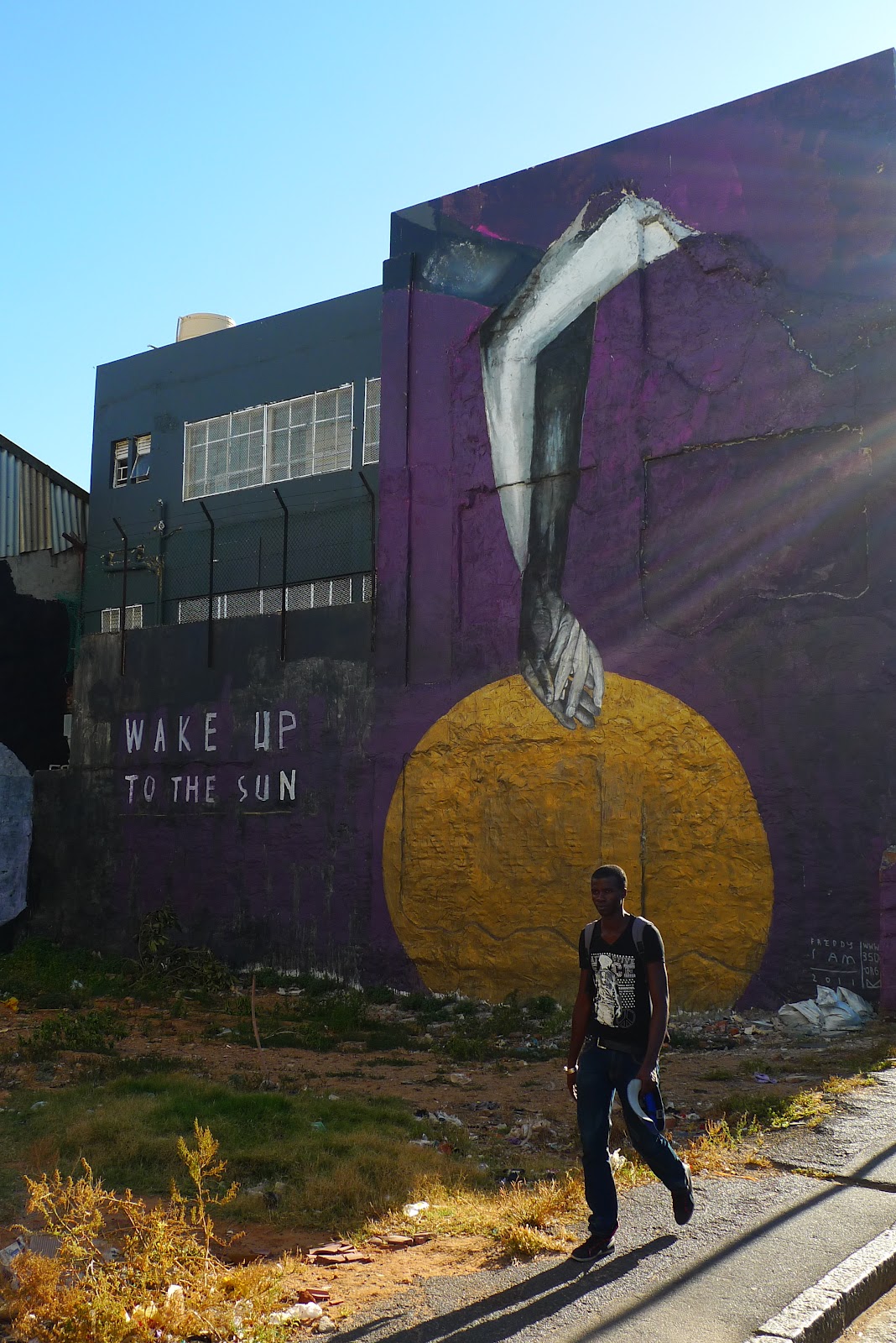
If only South Africa was this simple - the unifying black and white hand - yet racial divide is still massive.
Always good to know.
One of the elevator lobbies at a very cool art hotel in Johannesburg
The girl on my left is, for me, one of my success stories. She presented with a fungal meningitis, called Cryptococcus. It is associated with HIV. Mortality is rather high and she was desperately ill when I first admitted her in my second week here at Holy Cross. Now, five months later she is well, taking her HIV medications and a very happy lady indeed. Stories like this are some of the many reasons why I love my job.
The young girl in the green top is Wendy. She is the older sister of the girl on her left. Wendy was admitted in extremis with malnutrition, TB and was discovered to be HIV positive. She didn’t smile for two months until the week before her discharge. When I saw her this week she was laughing and running around like a child should. She appears to be thriving. The nurse is my favourite paediatric sister - she's been in the game since 1974.
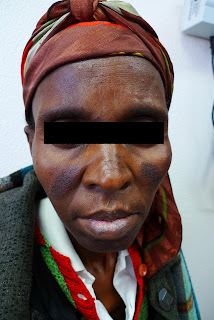
This lady is on HIV treatment - it appears to be failing. She has presented with a very nice example of a lupus like rash, which may well be HIV associated Lupus. I am waiting for blood results to see if the HIV virus has become resistant to her medication (often a result of patient's not taking medication regularly).