Thursday, 6 September 2012

Changing tyres is easy.


Bhamini relaxing above Lake Malawi at Mushroom Farm.

The dream is over; the trip has ended. Right now, I am huddling inside my rather large house at Holy Cross whilst the rain and wind beats down on my oversized sitting room window. Instead of beautiful vistas, it is just cloud and gloom. A pathetic fallacy some may say. However, despite a few first day blues, it is good to be back.

In case you were interested, let me try and scan over the last two weeks of our tour around east Africa in Mitch. As I left it, Bhamini and I had tended to a baboon stricken dog on top of a beautiful camp site looking over Lake Malawi in the north of the country. We didn’t really want to leave, but then it wouldn’t be a road trip – one must keep on moving. Malawi seemed to be full of medical students on their elective taking exceptionally long weekends away from their hospitals to explore the country. Not that I can blame them. In fact, I am pretty sure I did exactly the same thing. You’re only young once and all that.
 
Bhamini taking a photo of a pig on bike.

We were slightly anxious about entering Malawi as there were rumours of a fuel shortage, specifically diesel. Mitch drinks diesel like I drink tea (I love tea; I also wee a lot). Our nervous laughs and smiles were slightly amplified when the first two petrol stations we visited were e mpty. Good thing I brought jerry cans and a tow rope, I thought. However, it was a false alarm as every other filling pump in Malawi was more than happy to inject Mitch with his favourite juice. So, fuel not a worry, we were able to drive the length of Malawi.
At a small Italian run guest house we overheard a girl talking: “...so, these two doctors happened to have an entire medical kit in their car. They managed to stop the bleeding and patch the dog up. He would have died if they weren’t there.....,” or something like that. The dog incident was in the north of the country; we were 800km away in the south. For a second I thought we had become famous. However, it turned out that she was the girlfriend of the dog’s owner and happened to be passing through. It was the best thing our “medical kit” was used for over the two month trip. Right now I am slowly working my way through various medications from the box of treats to rid a few parasites that I probably picked up whilst swimming in the lush blue lakes of east Africa.

I say I can't remember what we did in Malawi - but, how
could I forget this campsite on an island in the lake that we had to
Kayak to. Domwe Island - check it out.

Other than eating nice cheese and some excellent gnocchi, tales of Malawi seem so far away. After that it was on to Zambia, where we failed to see any Leopards (they can be damn sneaky) and then commenced the long trip home. There I was, thinking that apart from two speeding tickets (the second in Malawi) and with three days left, we had managed to get through the entire trip without a hiccup. Cue: burst tyre.
It's all about the "High Vis."
Changing the wheel of a large car, or shall I say small truck, is rather difficult. Thank god we had our high visibility, a.k.a. we haven’t a clue, jackets on so that we could be spotted by some lovely guys from the local town. Without them we would probably still be there trying to undo the wheel bolts. With the new tyre safely on, we bombed it through Zambia and then drove the length of Zimbabwe in a day. And there it was, trip over. We met some friends in Johannesburg and waved an emotional goodbye to Bhamini: she flew back to the UK after
 a year in South Africa.
I have hundreds of stories, but I need to save some for the dinner table. I have compiled a brief list of some nice places to stay, just in case you decide to do a similar trip. You may notice that most places I recommend involve good food: I like to eat. They are in order of the route we took, rather than preference.
1.       Kapishya Hot Springs (ZAMBIA, in the northeast): Excellent food using vegetables from their garden, a very eccentric owner, off the beaten track (i.e. private transport is needed) and loads of friendly dogs of all shapes and sizes. Oh yeah, and there’s a really lush hot spring that you can soak your dirty body in until it goes white and leathery. Yum.
2.       Katavi National Park (TANZANIA, in the west): If you like tsetse flies, you’ll love this. They try their best, but a few bites and the prospect of sleeping sickness cannot put one off the untouched feel of this park. The campsite is set above one of the largest pods of hippos I have ever seen – an exhilarating camping experience.
3.       Paradis Malahide Hotel (RWANDA, Gisenyi): On the shore of Lake Kivu is a little gem where one can relax and do nothing but sleep, eat (really good fish, not surprisingly) and swim in the crystal clear waters for the tenth of the price of a gorilla permit.
4.       @theriver (UGANDA, Ishasha): Just outside Uganda’s infamous park that is home to tree climbing lions is a very affordable campsite that does some excellent grub and has pretty cool open showers looking onto the river where others like to wash.
5.       Bery’s Place (UGANDA, Ssese Islands): Not really a guesthouse, but as I described in a previous post, more of a refuge. However, Bery does take volunteers who can help with his foundation – the accommodation, food and company is really nice; the view of the lake isn’t bad either.
6.       Ruaha National Park (TANZANIA, in the middle): Not a tsetse fly in sight and there is more game than Noah would know what to do with. Not as unspoilt as Katavi, but not as overridden as the Serengeti.
7.       The Old Farm House, Kisolanza (TANZANIA, Iringa): the campsite looks like an English orchard – whether that’s what you want or not when in Africa is debatable. However, the three course dinner is scrummy and the restaurant has been converted from a derelict mud hut.
8.       The Crazy Crocodile (TANZANIA, Matema): Run by a German dude called Thomas, this new joint on the unspoilt beaches (well, now slightly spoilt) around Matema is a great base for a few days. It’s all about the food, although the portions are occasionally a little small.
9.       Mushroom Farm (MALAWI, Livingstonia): The place I mentioned in this and a previous post – campsite set on top of a cliff looking over Lake Malawi with some very enthusiastic dogs that like playing with baboons. The owner, Mickey, cooks a good steak.
10.   Casa Rossa (MALAWI, Zomba): Run by a couple of really nice Italian’s. They make really good cheese and pasta – I love cheese and pasta. Enough said. The accommodation isn’t bad either.
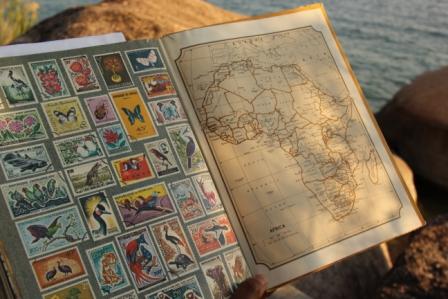


Charting our journey with stamps. Who needs a Sat Nav when you have one of these?

Tea and cows - the base of Mount Mulange, Malawi.


The last night - we had a duel.

Don't you forget it.

Two months on the road with one pair of shorts (the original colour is at the bottom)

Neanderthal


Wednesday, 22 August 2012

Monkey Business


"Don't Panic," the famous inscription on the back of The Hitchikers Guide to the Galaxy.
The audiobook served us well for the first few hours of our trip.


Bhamini, Liza and Dom at Lake Nyasa/Malawi

It has been a while since looking in the mirror. So, when I did that exact thing this morning, my first thought was: “Neanderthal.” A combination of a scraggy, although rather bushy beard, and wild unkempt hair that has forgotten what shampoo is, has given me an almost caveman look. No wonder children keep running away from me in horror – although I am sure I get a similar response at Holy Cross, so maybe it is just my slight maniacal grin.
The corridors of Holy Cross cannot seem further away right now as I sit on the serene shoreline of Lake Nyasa (A.K.A. Lake Malawi) in Tanzania. There is no longer that nervous anticipation of my mobile ringing with a call from maternity or casualty that has kept me on the tip of my toes for the past ten months. Now all I really need to think about is what are we going to have for dinner, will there be cold beers and don’t forget to take your malarial prophylaxis.
***
Between seeing old friends, we had an excellent time at the Ishasha
Reserve in west Uganda where we were entertained by hippos and
tree climbing lions.
Before entering back into Tanzania and after leaving Rwanda we spent a little over a week in southern Uganda. The lush green hills were as green as I remember them in 2008 (I mentioned that I was there in 2009, but I got my chronology wrong – in 2009 I was already swimming in the world of the NHS). We paid a fleeing visit to Rushere Hospital, a rural centre where I did half of my medical elective as a student in 2008. The main reason for my visit was to see Jonathan – he is a young dentist, who is eager, exceptionally bright and has an infectious dry sense of humour. He is a solid individual and I am sure that his presence for the past seven years, when it was only meant to be two, has made a lasting impact on the hospital and community. Jonathan, I salute you.
Whilst seeing Jonathan we bumped into a medical student on his elective at Rushere – much like myself four years ago. Just like I had felt then, he said that they (he was with friends) felt a little lost and overwhelmed at the hospital – there isn’t really anyone to supervise the students. Just as when I was there, the site is run on a skeleton staff of two doctors – one an alcoholic that barely leaves his house and the other, exceptionally overworked. The former has remained the same, whilst the latter changes every couple of years. How a human being can behave with such distaste is beyond me; how someone can stay in a job like that for so long? I expect they have family in high places.
***
Mitch riding the waves amongst the people en route
to the Ssese Islands.
This trip has almost turned into a mini pilgrimage – returning to see people and places that I almost worship. Of special mention is Bery’s Place. I visited Bery during one of the many long weekends that myself and friends took off whilst getting lost around Rushere on my medical elective. I was taken aback by what I saw then; my feelings remain the same now. Without going into too much detail (you can peruse his website – address at the end of this), he has set up a home on the Ssese Islands in Lake Victoria to give shelter, support, basic medical needs and a family to young girls that have been the victim of abuse – be it physical, sexual, psychological or anything else. It just so happens that the prevalence of HIV on these islands is amongst the highest in Africa. Why? Well, there are many reasons – however, I expect several strong contributors are that the population is very young, the young men make a lot of money fishing and many family units are broken or scattered. This leaves young people, especially girls, very vulnerable.
Bery and some of his family (Note Bhamini has joined
in with the fun).
Bery has given many girls a lifeline; the opportunity to do and achieve things that for most are mere hoop dreams. It doesn’t sound easy, and not everyone can be helped, despite all that is offered. I urge you to read about his foundation and contribute to the cause. If everyone did a little something like him, then I expect the world would be a better place. Of course, it is very easy for me to say that as I sit here admiring the beautiful view over Lake Malawi with a cold beer in hand.
***
Uganda was as much about revisiting a beautiful country as it was about paying homage to some exceptional people. At the end of the day, it’s the people that make a place what it is – one of the key driving forces keeping me at Holy Cross for another year. With people on my mind, we bombed it back into Tanzania to meet up with one of my best friends, Liza. Two days of solid driving down crappy roads, a very comfortable night’s sleep in a brothel (the pants on the bedroom floor, unopened condoms over the courtyard and a Madame by the name of Happy who’s guests seemed to check in and out on the same day may have given it away), one speeding ticket and an excellent Chinese dinner later (I mentioned the Chinese were building roads, so they need somewhere to eat) we eventually picked up our friend. So, three in the tent it was.
Setting up camp on the edge of Lake Nyasa
Most of our time was spent in Ruaha National Park where we slept surrounded by the roar of lions, and Lake Malawi, where I started writing this post. In the park we were the victims of crime: a troupe of hungry baboons snuck into our camp whilst we were on a safari (or game drive, if you’re South African). They emptied our spices, coffee beans and marinades all over the sand and took the precious chocolate and vegetables. Fortunately, much was salvaged and a lesson was learnt: never leave anything unattended when monkeys are around. I think we probably knew that lesson already, but something escaped us that day.
***
King and his patched up leg.
I started writing this entry in Tanzania and have finished it in Malawi. We arrived today and are perched upon the edge of a cliff, towering five hundred metres above Lake Malawi, in one of the most picturesque campsites I have ever set foot on. However, whilst in the middle of writing, Bhamini and I had our medical hands called upon. The Australian owner’s dog, called King, got bitten by a baboon. A good deal of blood later, and after a lot of pressure, the pooch stopped exsanguinating over my hands. Holy Cross has served me well: the tamponade of bleeding is our specialty.


Here’s the link for Bery’s place: http://berysplace.wordpress.com
  

Some snaps taken from our three day safari around Ruaha National Park in Tanzania: 


Ele and her crew heading for the shade of the Baobab tree.

One of my proudest moments as a "tracker" - I spotted this lioness stalking some buffalo

One just cannot get bored of their stripes

Post monkey assault - fortunately they didn't take the gin..

King of the jungle.

Who's going to be the leader of this journey?

Dom and Liza; the Amarula disappeared very fast.


Wednesday, 1 August 2012

Hugs.


"Wheely-fun"

Mr Silverback, having a little R&R just before he decides to
run into us.
 We are now halfway through our little drive around east Africa. Seven thousand five hundred kilometres later, Mitch still purrs like the day I first perched my bum on his soft greying seats. We remain malaria free, but are probably riddled with bilharzia from swimming in the irresistibly crystal clear lakes. Fortunately, we came prepared with a medical kit teeming with medicines, tinctures and voodoo dolls in readiness for such eventualities.
***
The past few days have seen us cross into Uganda, where I spent about five weeks as a medical student as part of an elective in 2009. Between my last entry and now, however, we spent a little over a week in Rwanda. Again, I was last there in 2009. I spent a weekend clubbing, adorned in glow sticks and dancing until my legs felt like jelly in Kigali. It may not have been the most informative introduction to a country, but gave me a real flavour of the people and strong desire to return. The country was all it lived up to be; right now it is possibly my favourite country on this beautiful continent. I wrote an email to a friend at the end of last week and said this about the place:
“What the people of this luscious land have been through, namely: the genocide, is unbelievable. However, the nation has come out thriving after hitting absolute rock bottom. Over a million humans slaughtered in a little over a month – absolutely unfathomable. It is so deeply moving to hear the stories of loved ones lost and the humanity that has ensued to rebuild a nation.”
Kids that give hugs.
Rwanda could be described as a nation of orphans and broken families. True as this may be, it’s people, the Rwandanese, have united with great strength and humility. We were fortunate enough to stay with Peter and his family. Peter is about my age and the cousin of a friend from home. Never have I met a more enlightened and awesome human being. I shall say no more, except to my sisters: “I think you may like him.” *wink, wink*
Seeing the mountain gorillas on the volcanic slopes of the DRC (Democratic Republic of Congo)-Rwandan-Ugandan border was without doubt one of the most magical and exhilarating experiences that I have ever encountered. But, you shall just have to do it yourself (and fork out the massive fee for the privilege) to understand what I mean. So, rather than write on and on about it, all I shall say is: “Go.” Don’t get me wrong, oh the gorillas were good, they were excellent, they were more than excellent; those super furry balls of fluff were splendiferous. However, they didn’t hug me (although, I have heard this isn’t an uncommon occurrence). Unabashedly, the most enchanting thing about Rwanda is how people greet: everyone gets a big hug, often on each side (like how the French greet, by throwing a kiss beside each cheek), with a warm and gentle handshake. If you know the person really well, there is a touching of the foreheads, almost akin to an Eskimo kiss. Imagine walking through a pack of twenty small school children and getting hugs from every single one of them – well that is what I did and I can say with certainty that it is truly spectacular. Fortunately, the salutations were confined to the villages as it would have made moving through Kigali, the capital, rather slow.
Myself,, Peter and his crew.
However, all this loveliness aside, there have been constant reminders of the strife that still beats in the heart of Africa. The regions that border the DRC are littered with UN (United Nations) refugee camps: a stark reminder of the plight of so many souls in the area; forced to leave their homes and live in tents for an indefinite time.
***
We are about to start the return leg back to South Africa. One month in and I have developed a rather bushy little beard – I think it is a slight improvement on the moustache I grew.


Mr Silverback spending time with the kids.

Hide and seek.


Primus - the Number 1 beer in Rwanda. It is tasty stuff.


So, lions climb trees in Uganda...

Monday, 16 July 2012

A short drive up through eastern Africa

 
Mitch, Mimi, Bhamini and Dom - fresh, clean and
 not really sure what to expect on the clean streets of Durban.
 

Botswana: home of possibly the longest, straightest
 road in the world. This is also the location of our
 first, and hopefully last, road kill - a poor bird sandwiched
 between Mitch and Mimi.

This blog, thus far, has generally revolved around my life at Holy Cross. For the most part, this is how I want to keep it. However, seeing as I am currently a few thousand miles from the hospital, sipping a gin and tonic whilst sitting on a veranda looking over Lake Tanganyika in western Tanzania, it is rather hard to write about work. As it happens, yes, the sun is setting and the piece of decking I have my bottom perched on happens to look straight to the west. So, for the rest of July and August, one can expect to hear a few scatty tales of what myself, my friend Bhamini and Mitch have been up to. My intention is not to show off, although I expect some of you may be rather envious of my current situation, as I would be, but to record a few events. The blog is as much for my own future records and nostalgia as it is to share with friends and family.  Secondly, it may also be a nice advertisement to any budding doctors (medicine is your passport to travel) or to anyone at a loose end and wanting a few ideas of what to do next. How about drive halfway up Africa and back?
***

Do not get between an mother and her child.

Since we departed from Durban on the last weekend of June, we have covered the distance of four rather large countries – South Africa, Botswana, Zambia and Tanzania. Thus far, Mitch has delivered us safely from one destination to the next. However, we have all become very dusty as the roads progressively get a little drier and bumpier. In fact, calling some of these tracks “roads” would be something of a debate. A few of these bridal tracks are mini deserts and others are miniature versions or the Rocky Mountains. If it wasn’t for the trusty satellite navigation system (we would be truly lost without it) that I updated with the entirety of the African continent – just in case – I think there would have been a lot of stopping and asking of fellow earth people if this track of theirs actually does lead to that national park that no one goes to because it is a little out of the way, but apparently is a hidden gem, except for the tsetse flies.  

Simba.

 As it happens, that national park – Katavi – in western Tanzania is the hidden gem the guide book says it is. Unfortunately, the guide book is also correct about the tsetse flies and the terrible roads. Mitch turned into a tsetse grave yard as they were flattened by the park map/hand/water bottle/finger or whatever blunt instrument was available whilst we scouted for game at the same time. If you have never been bitten by a tsetse fly, it’s a bit like being gnawed by a horse fly. Mean little critters. However, the flies didn’t ruin our fun. This was the Africa safari experience that I had envisaged before coming here. We camped looking over a river with the largest pod of hippos that I have ever seen. That night we had a quick dinner and made a swift ascension into the safety of Mimi (Mimi is the name of the roof tent as well as Mitch’s weekend alter ego), just after sunset, and waited. The noise was tremendous – Hippos sound a bit like very loud barking pigs doing unmentionable things to each other. Within a few minutes the hungry hippos were roaming around our car and munching on the lush long grass to fill their bellies after a busy day of doing nothing in the mud. It really was extraordinary as we lay there, heads poking out of the tent and watching them eat under the bright glow of the galaxy above, occasionally interrupted by the massive torch I bought for such events.
***
Buses like these driving at 100km per hour down a pot
 holed barren wasteland of road are a not
too uncommon sight in Tanzania.
 South Africa feels so different to every other country that I have been to elsewhere on this glorious continent. Yes, the roads may not be quite as good and there aren’t as many hospitals or politicians to play with budgets. However, doors are open. In general, there isn’t that fear that governs so much of South African society. In addition, literacy appears to be markedly better in the neighbouring republics. Notably, in Zambia, we passed a school every few miles (or at least it felt like that) and comprehension of the English language (the only vague marker I can use of literacy at a glance) is really rather good – something I cannot say for the community who live around Holy Cross. I understand that South Africa is a progressive society, but things feel much simpler and easier outside of it. I expect my glasses are exceptionally rosy as I haven’t had to deal with the oppression of military regimes, humanitarian infringements, and inequality in woman’s rights, homophobia, bent politicians and so forth. However, all I can say is what I see and what I appear to see is happy people. From when I was 18 and travelling/working through Ghana, Togo and Benin to when I was 24 and doing my medical elective in Uganda, and up to now, driving back up to Uganda via several east African countries – people seem happier than they do in South Africa.
***
I mentioned that the roads are progressively getting worse as we come north. So far, we have been bombing it up the “main roads” so that we can get to Rwanda to see gorillas on July 18th. But as I said – some are barely roads. However, I think this situation is a rapidly changing one. I remember reading and hearing news of the Chinese and their domination of Africa. It appears that in return for the richness that the soil has to offer, Chinese contractors are building roads, roads and more roads. They seem to have shipped over an entire work force of site managers and all of their own gear (trucks and diggers) to create endless highways of asphalt. We had our first experience of the lush smooth purr of tarmac last night after several hours of off road driving alongside the construction of these superhighways. I do wonder, however, if the roads will be maintained if the Chinese leave after they have had their fill of natural resources. Much like the British and other colonial powers did in former times – wash their hands of the mess that they had created. However, the Chinese haven’t colonised Africa so maybe things will be a little different.
***  

Some exceptionally keen amateur photographers
 in Chobe National Park, Botswana.
We are only 13 days into our trip, but have already covered a considerable distance. The reason we are going so fast, as I keep mentioning, is because we have two very expensive permits to see the endangered gorillas of central Africa.  Hence, we have had a lot of time sitting inside of Mitch and carving out some nice bottom shaped indentations in the seats. To date, we have listened to the audio book of The Hitchhikers Guide to the Galaxy; discovered that it can get very cold during the night in Botswana and that a 1 season sleeping bag does not suffice; made sure that the roof tent always has at least three blankets, as well as sleeping bags; seen how ugly the safari season can be in peak season at Chobe National Park in Botswana – think tens of open top game vehicles loaded with tourists (ourselves included) surrounding an unfortunate pride of lions; seeing how beautiful a safari can be from the  safety of Mitch  with not a human in sight, enveloped by a journey of giraffes, a dazzle of zebras, herds of buffalo, enjoying the odour of a pod of hippos and stumbling across a small pride of lions; rafted down the white waters of the Zambezi river at the base of Victoria Falls; got soaked by the spray of Victoria Falls; camped next to and swam in hot springs in Zambia; tracked chimpanzees in Gombe National Park – famed for Jane Goodall’s pioneering research into the primates.
However, possibly the best thing of all is that we have enjoyed freshly ground coffee every morning thanks to a very nifty little handheld grinder all the way from Japan. Actually, the coffee isn’t the best thing, but you may be able to tell that I am rather proud of this feat.


Chimpanze.


Up close and personal with some very shy elephants at Katavi National Park, Tanzania.

Camp for the night, in Katavi. About 30 metres behind me (I'm taking the photo) is a pod of around 100 hippos. 


A giraffe trying to eat whilst we take some snaps from the comfort of Mitch.


Friday, 6 July 2012

Hello from Southern Africa (not South Africa)

So, I shall keep this brief. Three weeks ago I flew home to surprise my mum for her sixtieth birthday (sorry for giving your age away, but you know you do not look a day over thirty). I think she was rather pleased. Being at home was absolutely wonderful – it reminded me of how lucky I am and what a surreal life I live at the moment. After an intense nine days in the UK I flew back to South Africa for a mere five days of work. I cannot lie (well, except for lying to my mother – but I had good intentions), it was a tough five days. Am I destined to do this for the rest of my life? I hope not. All I want in life, like most, is a family and to love and be loved. However, my narcissistic life was instantly thrown back to the ground during the one on call I did last week. I was summoned to casualty at 2 am after a car had lost control and collided with a rondavel – someone’s house. Sleeping just seconds prior to the accident were two mothers, each with a young child. Three were surprisingly well; unfortunately the youngest, an eight month old girl, died minutes before I arrived. It really did put things back in perspective. I have committed myself to another year at Holy Cross.
Now, why keep this brief? Well, before I give Holy Cross another year of “Dom in South Africa” I am taking two months of unpaid leave. My friend and I have started our trip up to Uganda and are currently in Zambia. For those bad on geography we passed through Botswana before arriving in Livingstone (Botswana), where we are now. Yesterday we stumbled around Victoria Falls (WOW) and today rafted down the white waters of the Zambezi. In four days we should be in Tanzania en route to Rwanda to see the Gorillas on July 16th. After that we shall have more time to relax and slowly work our way back down the continent.
Internet is bad, so no photos. If we do find a good spot maybe I shall write a bit more on the adventures of Dom and Bhamini (like harmony, but with a ‘B’) in Mitch or MiMi (Mitch’s weekend name).

Wednesday, 13 June 2012

Don't shoot.


Sunrise last week; sunset this week.

Before I mumble on with more tales from Holy Cross, could I urge you to  click on the following link and sign the “ePetition,” asking the Eastern Cape Department of Health to get organised. We have already lost one potential doctor as a result and there are other hospitals facing a very real prospect of being “doctor-less” by August – the implications of this are massive.
***
If you stumbled into casualty on Sunday evening you may have wondered why I was standing on top of an 80 year old patient’s bed with my leg in his armpit and pulling the man’s arm with all my might (may I add that my raw strength is probably equivalent to that of a five year old). Firstly, I do not believe for one second that he was 80. However, he was definitely pushing it and was built like the Terminator. This could be a slightly histrionic statement, but that’s how it felt. Years of working the land had made this elderly gentleman rather “ripped.” I guess you may be asking why I was pulling back on his arm, with a nursing colleague giving counter traction via a bed sheet strapped around his armpit. The old geeza had rather impressively dislocated his shoulder. Now, I have done this on two occasions myself (one skiing and one throwing some slightly over enthusiastic shapes on the dance floor) – it is exceptionally painful. Fortunately for myself, as mentioned earlier, I sometimes look a little malnourished (hence, a lack of muscle bulk) and I had my doctor friend George (we were medical students at the time) to slip it back in – I am and always will be eternally grateful for this. Hence, I could almost understand how the old fella was feeling.
In general there are three ways to dislocate a shoulder – either it comes forward (the commonest injury and what I had), goes backwards or heads down, into the armpit. He had all the classic signs of a dislocated shoulder: agonising pain, loss of the angle of the shoulder and reluctance to use the arm. However, his arm was also held abducted (i.e. hanging out – he couldn’t bring his arm to his side). A quick examination revealed that he had also sustained a possible nerve injury and that his humeral head (the ball joint at the top of ones humerus – quite self explanatory really) was sitting in his axilla (armpit). So, I gave him a good dose of pain relief and sedation, then tried my best to plonk it back with the assistance of two nurses.  
It is only the second dislocation I have seen here, but both have been inferior ones – from what I have read, they are rather rare and can be a bugger to relocate (orthopaedic colleagues, please correct me if I am wrong). The reason I keep mentioning muscle bulk is because the more there is, the harder it is to pull a joint back into position. Fortunately, the first time I saw this it was an elderly lady who’s shoulder was only slightly smaller than mine – I reduced it with no problem at all, except for her responding a bit too enthusiastically to the trickle or morphine that I gave her.
After 45 minutes of pulling, twisting, getting the book out, trying different manoeuvres and pulling again, I accepted defeat. I think this point was realised when I found myself using the bed as a pivot to lean back and almost falling over from my own fatigue. So, I sent him to our orthopaedic hospital with plenty of analgesia in his system – a bumpy 4 hour trip is not ideal at the best of times, let alone with a fracture or dislocation.
***
Assaults are common here; so are guns. Hence, there is a big sign on the hospital front that clearly says: “No guns.” It makes sense, hospitals are places for healing; guns are designed to cause harm. There I was performing an examination on a security guard from a supermarket in town, who had been beaten up by a couple of men. He told me that the men were having an argument in the store, so he tried to break up and settle the dispute, or at least move it outside. Instead of agreeing they gave him a few punches and ran off to fight elsewhere.
The guard was fine, but as I asked him to: “Khulula,” (undress, in Xhosa), I found that he was packing heat. For a little clarity, that is the “gangsta” lingo for carrying a firearm. It just so happened that at this point my nurse had popped out of the consulting room and it was only the two of us. I very kindly told him that yielding a gun in a hospital was completely unacceptable, but decided to leave it at that. I was more concerned that if I alerted the security, the situation could have gone from very pleasant to bang, bang.
***

Medical ward can be hard work, both mentally and physically. However, yesterday I discharged a nice lady who had suffered a stroke. Before I had time to blink, she hobbled up to me (it’s not so easy to run when half of your body doesn’t do what you tell it) and gave me lots of kisses and a showering of: “Siyabonga, siyabonga,” (thank you, thank you). It’s these moments of spontaneity that one just doesn’t get in other lines of work – I wouldn’t change my job for anything.
  
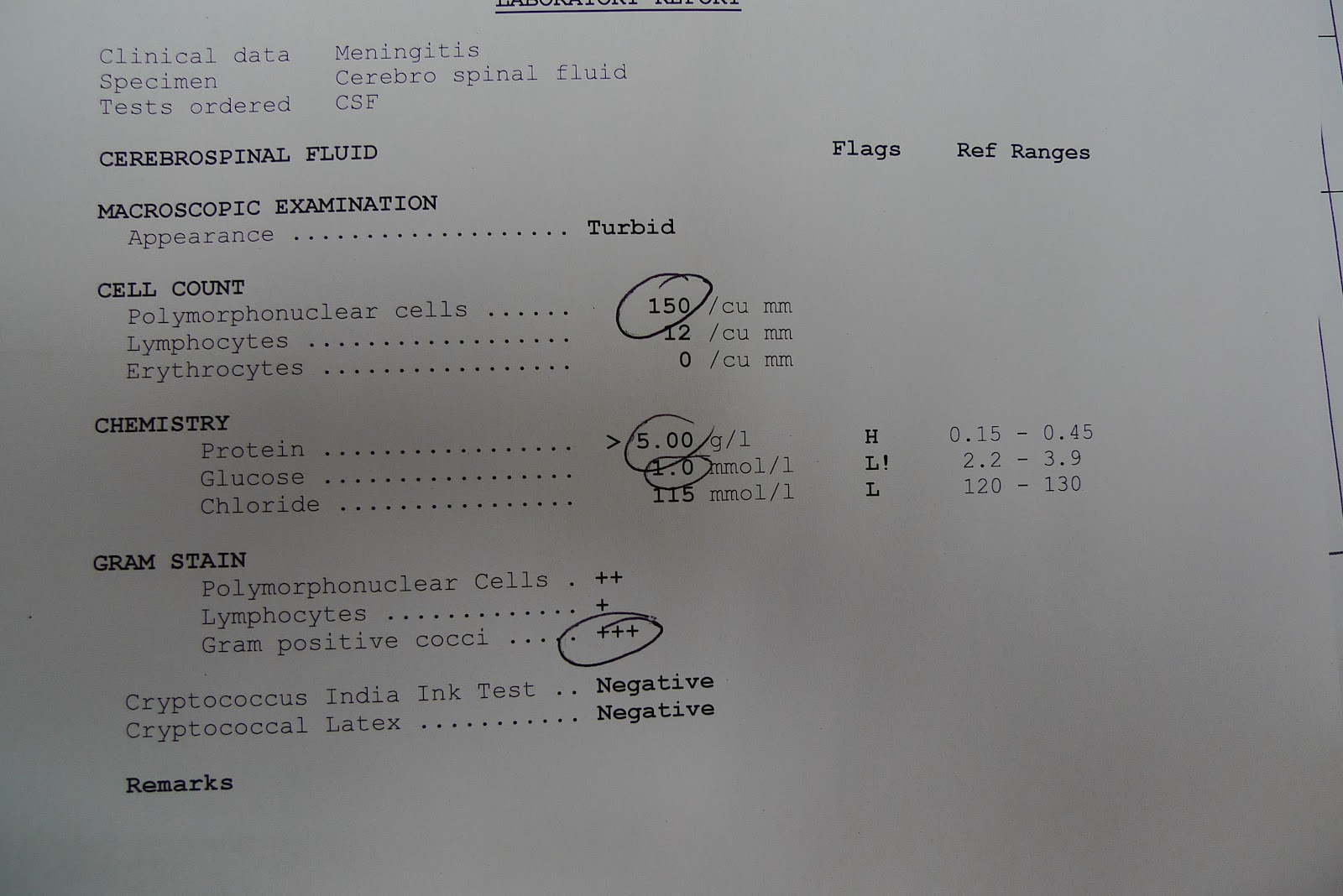
A classic CSF picture of bacterial meningitis. Unfortunately, the young man was dumped onto a bus in Durban back to the Eastern Cape and by the time I saw him he was too far gone. He died later the same day.

This is the chest xray of a rather well looking young man who had some persistent TB symptoms. The big blob in the middle is his heart surrounded by a load of fluid (pericardial effusion) that I confirmed on ultrasound. Extrapulmonary TB is the commonest cause of pericardial effusions here.


This lady had fallen over the week prior and was hobbling around in excruciating pain. Notice that her left leg is a little shorter than her right and that the left ankle is rotated outwards. This is a typical of a fractured hip.

A very jaundiced patient. Notice the reflection of my favourite Sister in medical ward.

This is the young mother who had Steven's-Johnson Syndrome - she is on a full road to recovery and I have sent her home to be with her child. She's due to come back for review in two weeks. (Images use with permission of patient)

A massive lipoma (fat deposit) that I removed from a lady's arm. An exceptionally satisfying procedure.

Sunday, 3 June 2012

Vacancies.

Vacancies - please submit your CV.

There is a lot of excitement in my household at the moment and, seeing as it is only I who lives within this abode large enough for a family of four, I can dance around with as much glee as I care. For in exactly one month, I shall be saying goodbye to Holy Cross and embarking on a little overland trip with a friend in Mitch, the four by four off road machine, up to Uganda and back. I am sure I will be giving out plenty of snaps from the trip when the time comes and maybe a few tales too. Fingers crossed Mitch is good for it.
***
After originally being struck by the amount of HIV and young people dying in all manner of undignified ways, although I am not quite sure what is a dignified way to go (at home, in bed I suspect), something else bothers me far more. Just the other day I was counselling a girl of 15 who had a threatened miscarriage. One cannot stop people from having sex, even at this young age. However, she, like many before her, laughed when I mentioned the importance of an HIV test and said that she was not ready for one. After a bit more discussion she agreed to the test. If getting young people to test for HIV is difficult, then surly it is even harder to encourage them to practice safe sex.
Last week I performed a sexual assault examination of a 14 year old girl who was abducted and taken 100km away to a location near Holy Cross. However, despite this distressing story, she had clearly been sexually active for some time: her genitals were covered in warts and there was a very offensive discharge. It transpired her boyfriend was not very keen on condoms and that he probably had a few other girlfriends too.
It is always the woman that we see in clinic with the sexually transmitted diseases and early pregnancies. Rarely one sees the men coming for sexual health related issues. It is the men that really need to be educated, and, therein lies the problem. There are a few good initiatives nationwide, but I am not aware of any around here. There is a very successful clinic run on Saturday mornings near Johannesburg led by all male nurses. I expect many men around here have difficulty discussing their “man-hood” with female nurses as local culture still dictates a divide amongst the sexes.
Talking of family planning – there are a lot of dogs that roam the roads of the Eastern Cape; there are also a lot of flat dogs that line these roads. A colleague pointed this out the other night - how can there still be so many dogs. The boss replied: “It’s canine family planning. Without it, they would overwhelm the area.”
***
On every casualty or outpatient card there is a brief history of the presenting complaint. Often I take a quick glance, but a lot of the time something has been lost in translation. For example, it may read: “15 year old, has been coughing for 5 days, is severely dyspnoeic and unconscious.” A brief inspection of the patient reveals that they are awake and breathing just fine. However, this week I forgot to read the “blurb,” and just dived straight into my history:
Me: What brings you here today?
Patient: I have a cough.
Me: Oh, how long have you had this cough for.
Patient: Since 1982.
Me: *my face scrumples up, I give him an “are you serious” look*
Patient: *gives me “I am deadly serious” look back*
At this point, I decide to read the outpatient card – he had come to pick up medication for his epilepsy. However, now I had started on this cough story, I had to finish. I think I cough more than he does, but, nonetheless he wanted me to give him something for it. It was almost as if he was bargaining with me – he had a pretty good poker face. However, once I agreed to dispense my secret weapon (paracetamol) he relaxed immediately and I advised him to test his sputum at clinic for TB.
***
I would like to end this little piece with a small plea. Perhaps I should have started with it, however, if you are still reading now then you must have, at the least, a small tickling interest in the health system here. Budget constraints or, more likely, mismanagement of funds (what some may call corruption or fraud. This is only my guess and I would never accuse the Eastern Cape Department of Health of such things) has had a visible effect on local health services. Similar tunes are being echoed in the British NHS.  However, it seems as if things are going from bad to worse: the health department has said that they cannot fund any new posts for doctors, or at least this is what I have read in articles and heard from various mouths in management.
Holy Cross, comparatively, has it pretty good at the moment with eight doctors. We are expecting two more, but news has just arrived that they may not be able to work here (despite vacancies) as there is no money. It is likely they will be wooed by one of our neighbouring provinces, such as Kwazulu-Natal. Of more immediate concern, however, are the hospitals that, come August, could possibly be with no clinicians at all. It is a very real possibility and unless the government steps in (who at this moment are piloting a national health insurance scheme) or the local department of health gets its act together, communities shall be without emergency medical, obstetric and paediatric care that could have grave consequences.
So where best to start: a petition. A good friend of mine, who is working in one of these soon to be “doctor free” hospitals, has petitioned the Eastern Cape Department of Health. Please log on, sign it and spread the message.
The link is:
If the link does not work, please let me know.

My hand is on the left and on the right is a patient who has a haemoglobin of 2 (severe anaemia). I checked mine and it was 16. Needless to say, she received a blood transfusion to help her gross fatigue and exertional breathlessness.